Irq Bitig – Az ótürök jóskönyv – A jóstürök ókönyv
Az Irq Bitig olykor gyöngébben Irk Bitig alakban szerepel; még gyöngébben, angolkodón Book of Omens or Book of Divination. Ez az eggyetlen eggy ma ismert olyan könyv, amely ótürökül, ótürök írással is íródott.
Nehéz a korát is meghatározni, de a mai ismereteink szerin 9. századi kézirat, amelyet a Könyvtár-barlangban fedeztek föl. Tunhuang mellett … ahol a Góbi sivatag találkozik a Selyemúttal …
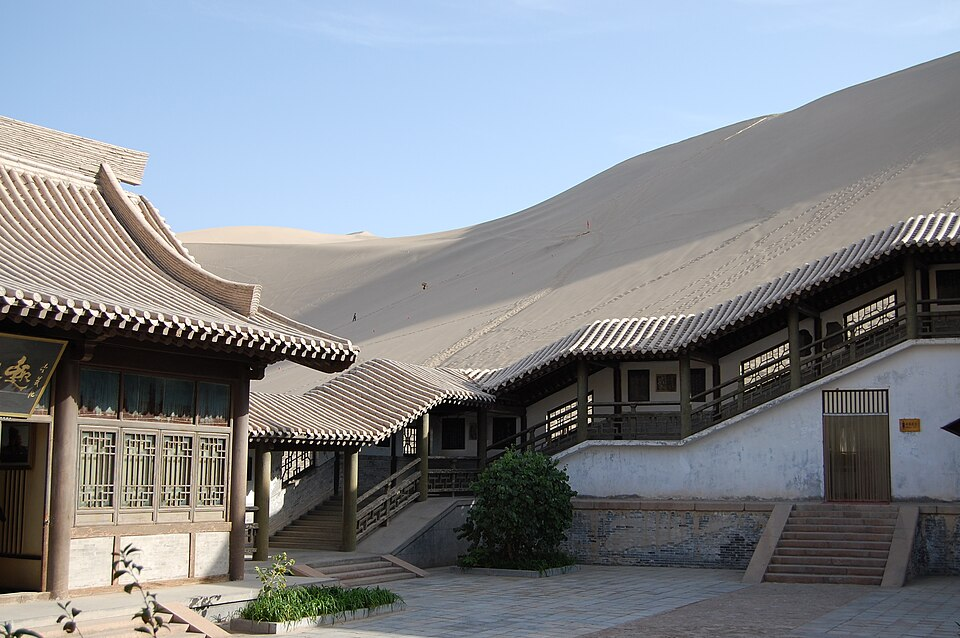
Túnhuang (kínaiul: 敦煌市) (listenⓘ) ma megyei jogú város Kína Kanszu tartományának nyugati peremén, a Góbi-sivatag szélén.
A Selyemút kereskedelmi karavánjainak egyik fontos megállóhelye és ellenőrző pontja volt. Később kínai helyőrségi központ volt, de a Belső-Ázsiából és Indiából érkező karavánok útvonala is erre vezetett. A hely jelentőségét az adta, hogy a Kelet-Turkesztán felé vezető Selyemút Tunhuang közelében válik két ágra, hogy északról, illetve délről megkerülje a félelmetes Takla-Makán sivatagot.
Tunhuangtól délkeletre mintegy 15 kilométer távolságban egy sziklafalban találhatók a Mokao-barlangok, más néven az „Ezer Buddha barlangtemplomok” amelyek kőbefaragott kápolnák, falaik pedig alaposan kidolgozott falfestményekkel és ember-nagyságú festett szobrokkal vannak borítva. Ezekből a legtöbb a Tunhuang oázisban található.
A 4. század közepétől virágzó Budda-hitű közösség élt itt, amelynek tagjai mintegy ezer éven keresztül építették és díszítették e barlangszentélyeket. Ma 492 barlangban 45 ezer négyzetméternyi falfestmény és több mint 2000 stukkó szobor alkotja azt a csodálatos művészeti együttest, melyet a világ legkülönlegesebb Budda-hitű művészeti együtteseként tartanak számon.
1900-ban egy taoista szerzetes felfedezett a Mokao-barlangokban egy titkos üreget, amelynek bejáratát a 11. században zárták le. A rejtekhely a rendkívüli szárazság következtében több tízezer kéziratot, valamint selyemfestmények kivételes gyűjteményét őrizte meg igen jó állapotban. A kéziratokon kívül a barlangkönyvtárban találták meg a világ legrégibb nyomtatott könyvét: a 868. május 11-re datált Gyémánt szútrát.[4] Ennek a fedőlapja egyben a legrégebbi fennmaradt kínai fafaragvány.
y manuscript book on divination that was discovered in the „Library Cave” of the Mogao Caves in Dunhuang, a már akkor Kína megszállása alatt, by Aurel Stein in 1907, and is now in the collection of the British Library in London, England. The book is written in Old Turkic using the Old Turkic script (also known as „Orkhon” or „Turkic runes”); it is the only known complete manuscript text written in the Old Turkic script.[1] It is also an important source for early Turkic mythology.
The International Dunhuang Project
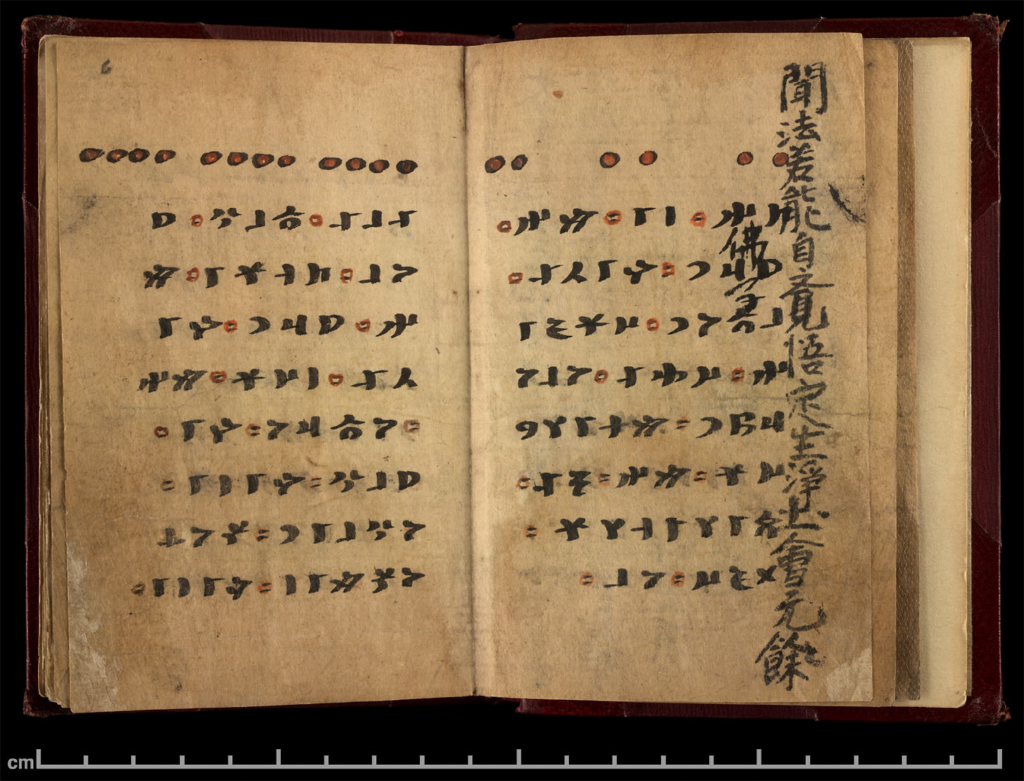
The only extant version of the Irk Bitig is a manuscript from the Dunhuang Library Cave that is now held at the British Library (shelfmark Or.8212/161).
The manuscript is in the form of a booklet comprising 58 folios folded in half, each page being about 13.1 × 8.1 cm in size. The pages of the booklet turn to the right (opposite to that of Western books), and the Old Turkic text is laid out in horizontal right-to-left lines running top-to-bottom down the page. The text of Irk Bitig consists of 104 pages in 52 folios (folios 5b–57a), with 40–70 characters per page.[2] The text is written in black ink with red punctuation marks marking word division, except for the colophon on the last two pages, which is written in red ink. The first four and a half folios (including one line overwriting the start of the Old Turkic text) and the last three folios (of which one and a half folios overwrite the Old Turkic colophon) are Buddhist devotional verses written in Chinese. As the Chinese text overwrites the beginning and end of the Old Turkic text, it is believed that the text of Irk Bitig was written first, and that the blank pages at the start and end of the booklet were later filled with the Chinese Buddhist verses.[1]
The title by which the book is known, Irk Bitig, meaning „Book of Omens”, is given at the bottom of the last page of the main text (folio 55b), but the author is not mentioned anywhere.[1]
A number of transcription errors and textual omissions have been identified in the manuscript text, which suggest that it is not an original composition but a copy of an earlier text that was probably written in the Old Uyghur script.[3] On the basis of its linguistic features, Marcel Erdal has dated the composition of the original work to the 8th and 9th centuries, among the earliest group of Old Turkic texts.[4]

Study of Antiquity and the Middle Ages
The oldest surviving document in Old Turkic, the Irk Bitig is the Book of Omens for the ancient Uyghur culture of Central Asia. Written around 1200 years ago, this small book was found in the Thousand Buddha Caves outside Dunhuang in Gansu, western China. Containing 65 omens that could be divined by the use of prayer sticks or bone dice, these were likely an animist oral tradition that predates the written word and Buddhism in the region.
This episode became as much about crafts and texts as it did voice and images. Divination is a cultural tradition that is nearly universal across all regions and eras. So I bought knucklebones on Etsy and a woodburning tool. I fashioned prayer sticks and I made my own artful little book. To better understand the document, I adapted the Book of Omens from its transliteral versions into a more accessible attempt.
Forrásaim / Kaynakça :
- Irk Bitig: The Book of Omens
turk-tili.comhttps://turk-tili.com › irq-bitig – The Irq Bitig or „The book of Omens” is the only Old Turkish text written in the Turkish script and in the form of a book.
- Skrine, C. P. (1971). Chinese Central Asia. Methuen, London. Reprint: Barnes & Noble, New York. 1971. ISBN 0-416-60750-0.
- „Dunhuang Studies – Chronology and History”. Silkroad Foundation. 2016. március 3.
- Makinen, Julie (2014. szeptember 27.). „Getty Institute helps save China’s Mogao Grottoes from tourism’s impact”. Los Angeles Times.
- https://it.wikipedia.org/wiki/Dunhuang#/media/File:Mondsichelsee-03.JPG
- https://it.wikipedia.org/wiki/Dunhuang
- https://fr.wikipedia.org/wiki/Dunhuang
- https://hu.wikipedia.org/wiki/Tunhuang
- https://en.wikipedia.org/wiki/Dunhuang
- Nyáry Szabó László : TÖRÖK-MAGYAR SZÓTÁR, Torontál Kiadó, Szeged (kiadás előtt még kézıratossan)
- https://sozluk.gov.tr/kelime/simit – Török Állami Nagy Kütyüszótár (Sz.) – TÜRK DİL KURUMU / Güncel Türkçe Sözlük
- Nyáry Szabó László : Szabó-szótár / ideolektusom (mind-máig digitális „kéz”- ill. „gép”-ıratban)
- (Sz.) : Számozatlan, forrásolatlan saját(os) alkotású) szójavallataim
- https://tr.wikipedia.org/wiki/Simit#/media/Dosya:Bought_and_eaten_on_the_street_Turkish_bread_and_pastry_are_usually_obtained_from_street_vendors_and_then_eaten_on_the_street._LCCN2010650580.jpg
