Rögtön az elején leszögezendő, hogy maguk az ázeriek is gyakran tiltakoznak nyelvük e neve ellen, mondván, hogy a nyelvük ázerbajdzsáni. Ez kívülről bizony nehézkesnek és hosszúnak tűnik. A „baj” meg nem hangzik jól magyarul. Ázer-baj-dzsáni … Minek még ragozni is ! És éppen a „dzsán”-nal, a ‘lélek’-kel ?! Igazán fölösleges (lenne)…
Így nekünk ők biz maradnak az ázeriek…
Megjegyzem, nem csak mi vagyunk így ezzel… Hallottam tatártól is ázeri néven emlegetni őket… ázeridzse néven meg a nyelvüket …
De gyakran azt is hangoztatják, hogy a nyelvük török.
Tulajdonképpen csak a töröknek eggy nyelvjárása. Van benne igazság …

A saját államisággal rendelkező türök nyelvek a Török, az Ázeri, meg a Türkmén,
a szétszóratott, más uralom alatt élő apró népek : a Gagauz, a Qasqáj, a Csaharmahali, a Khoraszáni meg a Szalár …
E nyelv az önnevén Azərbaycanca, آذربایجانجا, Азәрбајҹанҹа [ejt : azerbajdzsandzsa] vagy Azeri, azaz Azerbajdzsáni török önnevükön Azərbaycan türkcəsi, آذربایجان تۆرکچهسی, Азәрбајҹан түркҹәси, angolkodón írva meg Azerbaijani [ejt : /ˌæzərbaɪˈdʒæni, -ɑːn-/ AZ-ər-by-JA(H)N-ee]


Két fő nyelvterületre oszlik : az Azerbajdzsánban élő északi meg az Iránban élő déli nyelvváltozatra.
Ezek különbségeiket tekintve nyelvjárásként értelmezhetőek.
Magyar szemmel érdekes lehet, hogy egy nép déli fele egy másik országban él…
A mi TriaNon-unktól ez abban különbözik, hogy nekik saját ezeréves birodalmuk soha nem volt…
Az ázeri nyelvről alapvetésekben
• Az ázeri nyelv története elválaszthatatlan az oszmán-töröktől
• Ma is nagyon közel áll a (törökországi) törökhöz, bár…
• Az ázeriek könnyebben értik a törököt, mint a törökök az ázerit (talán a töméntelen TV-sorozat miatt is)
• Az ázeri tudóinak (németkedőn/angolkodón beszélőinek) ma a száma kb. 30 millió
• Azerbajdzsánon kívül kissebbségben Irán, Iraq, Törökország, Örményország, Khartvélország (Grúzia), Qazaqország, Özbekország meg Afgánország területén élnek …
• A nyelv lejegyzésére korábban az arab-perzsa írásjeleket, majd a kürilli abc-t használták (1939-1990), ma meg (1991 óta) az ázerire módosított latin abc-t alkalmazzák.
• A Szovjetunió általi megszállásuk idején a kénytelen kétnyelvűség volt a jellemző
• E nyelv erős arab-perzsa hatás alatt áll az alaktan (morphologia) területén is.
Az ázeriben X, x meg Q, q betűk is vannak, amelyek a törökben nincsenek.
| Régi latin betűk (1929–1938) | 1991 óta hivatalos a latin betűs írás | Kürill írás 1958-tól (Dagesztánban még mindig ez a bevett.) | Persz(o)-arab írás Azerbajdzsán-ban 1929-ig (Iránban ma is ez a hivatalos írása.) | IPA |
|---|---|---|---|---|
| A a | А а | آ / ـا | /ɑ/ | |
| B в | B b | Б б | ب | /b/ |
| Ç ç | C c (török mintára) | Ҹ ҹ | ج | /dʒ/ |
| C c | Ç ç (török mintára) | Ч ч | چ | /tʃ/ |
| D d | Д д | د | /d/ | |
| E e | Е е | ئ | /e/ | |
| Ə ə | Ә ә | ا / َ / ە | /æ/ | |
| F f | Ф ф | ف | /f/ | |
| G g | Ҝ ҝ | گ | /ɟ/ | |
| Ƣ ƣ | Ğ ğ (török mintára) | Ғ ғ | غ | /ɣ/ |
| H h | Һ һ | ح / ه | /h/ | |
| X x | Х х | خ | /x/ | |
| Ь ь | I ı (török mintára) | Ы ы | ؽ | /ɯ/ |
| I i | İ i (török mintára) | И и | ی | /i/ |
| Ƶ ƶ | J j | Ж ж | ژ | /ʒ/ |
| K k | К к | ک | /k/, /c/ | |
| Q q | Г г | ق | /ɡ/ | |
| L l | Л л | ل | /l/ | |
| M m | М м | م | /m/ | |
| N n | Н н | ن | /n/ | |
| Ꞑ ꞑ | – | – | ݣ / نگ | /ŋ/ |
| O o | О о | وْ | /o/ | |
| Ɵ ɵ | Ö ö | Ө ө | ؤ | /œ/ |
| P p | П п | پ | /p/ | |
| R r | Р р | ر | /r/ | |
| S s | С с | ث / س / ص | /s/ | |
| Ş ş | Ш ш | ش | /ʃ/ | |
| T t | Т т | ت / ط | /t/ | |
| U u | У у | ۇ | /u/ | |
| Y y | Ü ü | Ү ү | ۆ | /y/ |
| V v | В в | و | /v/ | |
| J j | Y y | Ј ј | ی | /j/ |
| Z z | З з | ذ / ز / ض / ظ | /z/ | |
| – zöngés torokzárhang | ʼ | ع | /ʔ/ | |
Az ázeri nagy Х meg kis х – ami nem a latin x fejleménye – magától értetődően a hellén χ (khí) származéka, ekként az orosz kürillica hagyatéka. İllendőbb volna az ótürök rovásból meríteni e hang ma írott betűjét (is) !
Az (észak)ázerbajdzsáni – a töröktől eltérően – a neveket is átbetűzi a saját kiejtésére. Bush > Buş / Schröder > Şröder.
Az ázeri nyelv hangtani jellemzői
Az ótürök hosszú magánhangzók eltűntek
Az ótürök y-megmaradt, de magas nyelvállású magánhangzók (vokálisok) előtt eltűnt.
• ótürök yılan > ázeri iilan ‘kígyó’
• ótürök yıl > ázeri iil ‘év’
Az ótürök nyelvhez képest a –v előtti magánhangzók ajakkerekednek (labializálódtak).
• ótürök av- > ázeri uv- ‘vadászni’
Az ótürök (szó)kezdő ká gé-vé változott / k-> g- (akárcsak a törökben)
• ótürök kel- > ázeri gel- ‘jönni’
• ótürök ket- > ázeri git- ‘menni’
Az ótürök hátul ká hátul gá-ra változott / q-> γ-
A torok-gá itt görög gammával jelölve szerepel.
• ótürök qara ‘fekete’ > ázeri γara
• ótürök qal- ‘maradni’ > ázeri γal-
• ótürök qıl- ‘csinálni’ > ázeri γıl-
Az ótürök té zöngésedett / t- > d-
• ótürök taš ‘kő’ > ázeri daš
• ótürök tört ‘4’ > ázeri dörd (a szó végén is)
• ótürök toz ‘por’ > ázeri doz
A hátul-ká (veláris ká), a -q spirantizálódott (-χ)
• ótürök baq-‘nézni’> ázeri baχ-
• ótürök yoq ‘nincs’, ‘nem’ > ázeri yoχ
• ótürök yaqşı ‘jó’ > ázeri yaχşı
Mássalhangzó-kettőződés / Jellemzőek az ázeri nyelvre a kettőződő mássalhangzók (gemináták).
• A számokban is yeddi, səkkiz, doqquz meg sok másban is… eşşek, meg a çaqqal, a ‘sakál’, amely szavunk a perzsa شغال [ejt : saġâl ] szóból ered az oszmán török چقال (çakal) [ejt : csakál] alakon át. (Ugyaninnen származik az angol jackal /ˈd͡ʒækəl/ is, amely a franci chacal(e) közvetítésével jutott a ma legismertebb nyelvbe, meg a német schakal, meg az olasz ciacale is innen fakad. Érdekes a szanszkrit शृगाल (śṛgāla) hasonlata is.)
Szókezdő magánhangzó előtt helyenként megjelent a h-betoldódás (h-protézis)
• ótürök örümçek ‘pók’ > ázeri hörümçek
• ótürök ürk- ‘félni’ > ázeri hürk-
Az ótürök szókezdő b- zöngétlenedett / b->p- olykor (sporadikusan)
• ótürök bıçaq > ázeri pıçaχ
• ótürök bol- ‘lenni’ > ázeri pol-
A csé hangokat (ál)tudományoskodón olykor cseheskedőn č betűvel jelölik, de ez teljességgel fölösleges. Van a töröknek erre saját betűje(le). Az ázeriek pedig (inkább) a közeli törökökhöz húznak. Sőt 1991 óta így, minden csét ezzel a ç betűvel is írnak. Ugyanez igaz a szlávoskodó, cseheskedő š-ek képtelenségeire is. Az ázeri 1991 óta, minden essét ezzel a ş betűvel is írja. İllik nekünk is ehhez tartanunk magunkat, ha róluk írunk vagy tőlük idézünk…
A törökkel szemben az ázeri nyelv külön jelöli
az elöl-kát „k”-val meg a hátul-kát „q”-val :
| ázeri (török) | török | magyar |
|---|---|---|
| ayaq | ayak | láb |
| ayaqqabı | ayakkabı | lábbeli / cipő |
| daş | taş | kő |
| qardaş | kardeş | fivér / testvér |
| qan | kan | vér |
| qaz | kaz | liba |
| qaş | kaş | szemöldök |
| qar | kar | hó |
| kitab | kitap | könyv (arab eredetű) |
Az ázeri számok
| számjegyek | szavakkal |
|---|---|
| 0 | sıfır [mélly ı-val ejtve : szıfır ] akár a törökben |
| 1 | bir akár a törökben |
| 2 | iki akár a törökben |
| 3 | üç [ejt : ücs ] akár a törökben |
| 4 | dörd – a törökben dört |
| 5 | beş [ejt : bes ] akár a törökben |
| 6 | altı [mélly ı-val ejtve : altı ] akár a törökben |
| 7 | yeddi [ejt : jeddi ] – a törökben yedi |
| 8 | səkkiz [nyílt æ-vel ejtve: szækkiz ] – a törökben sekiz |
| 9 | doqquz [hátul k-val ejtve: dokkuz ] – a törökben dokuz |
| 10 | on – talán e türök számszó él túl Ond vezérünk nevében is… |
| 20 | iyirmi [ejt : ijirmi ] vagy irmi (a törökben yirmi) |
| 30 | otuz (akárcsak a törökben) |
| 40 | qırχ [ hátul k-val meg mélly ı-val ejtve: kırh ] (a törökben kırk) |
| 50 | əlli [ejt : ælli] (a törökben elli) |
Rövid összegzésül ajánlom még az Ethnologue oldalát : https://www.ethnologue.com/language/aze/

Azerbaijani
Summary
Azerbaijani is classified as a “macrolanguage” in the ISO 639 standard and is assigned to [aze] as its three-letter code. Macrolanguages were introduced into the standard in order to reconcile the fact that in some usage contexts the entity represented by the three-letter code is deemed to be a single language, while in other usage contexts it is subdivided into two or more individual languages, each of which has its own code. The individual languages that make up this macrolanguage are listed below.
Languages
Ajánlott forrás-irodalom
Bulut, Christiane (2018b). „The Turkic varieties of Iran”. In Haig, Geoffrey; Khan, Geoffrey (eds.). The Languages and Linguistics of Western Asia: An Areal Perspective. Walter de Gruyter. p. 398. ISBN 978-3-11-042168-2.
Azerbaijani language at Ethnologue (25th ed., 2022)
„Azerbaijani, North”. Ethnologue. Archived from the original on 5 June 2019. Retrieved 2 February 2020.
„Azerbaijani, South”. Ethnologue. Archived from the original on 5 June 2019. Retrieved 2 February 2020.
Azeri Arabic Turk standard of writing; authored by Javad Heyat; 2001 http://www.azeri.org/Azeri/az_arabic/azturk_standard.pdf
„Türk dili, yoxsa azərbaycan dili? (Turkish language or Azerbaijani language?)”. BBC (in Azerbaijani). 9 August 2016. Retrieved 15 August 2016.
Goyushov, Altay (26 September 2018). „The Language of Azerbaijan: Turkish or Azerbaijani?”. Baku Research Institute. Retrieved 23 August 2023. However, in 1936–1937, the situation changed fundamentally. Even though there was no explicit mention of an enactment of state language in local Azerbaijani laws, the term „Turkish” was substituted by „Azerbaijani” in state and court documents. Later in 1956, „Azerbaijani” was given the status of the official state language of Soviet Azerbaijan. This was also mentioned in Soviet Azerbaijan’s last Constitution adopted in 1978.
Doerfer, G. (2011). „Azerbaijan”. In Yarshater, Ehsan (ed.). Encyclopædia Iranica. Vol. III/3: Azerbaijan IV–Bačča(-ye) Saqqā (Online ed.). Encyclopædia Iranica Foundation. § viii. Azeri Turkish, pp. 245–248.
Rahmati, Nemat (1998). Aserbaidschanisch Lehrbuch : unter Berücksichtigung des Nord- und Südaserbaidschanischen. Korkut M. Buğday. Wiesbaden: Harrassowitz. ISBN 978-3-447-03840-9. OCLC 40415729.
Ajánlott olvasmányok :
- Stein, Heidi (2014). „Ajem-Turkic”. In Fleet, Kate; Krämer, Gudrun; Matringe, Denis; Nawas, John; Rowson, Everett (eds.). Encyclopaedia of Islam (3rd ed.). Brill Online. ISSN 1873-9830.
- In Honor of the Turkologist!: Essays Celebrating the 70th Birthday of Ekrem Čaušević. Zagreb: Faculty of Philosophy in Zagreb. 2022. pp. 103–105. ISBN 978-953-175-937-3.
- „The Turkic Languages”, Osman Fikri Sertkaya (2005) in Turks – A Journey of a Thousand Years, 600–1600, London ISBN 978-1-90397-356-1
- Wright, Sue; Kelly, Helen (1998). Ethnicity in Eastern Europe: Questions of Migration, Language Rights and Education. Multilingual Matters Ltd. p. 49. ISBN 978-1-85359-243-0.
- Bratt Paulston, Christina; Peckham, Donald (1 October 1998). Linguistic Minorities in Central and Eastern Europe. Multilingual Matters Ltd. pp. 98–115. ISBN 978-1-85359-416-8.
- Johanson, Lars (2011). „Azerbaijan”. In Yarshater, Ehsan (ed.). Encyclopædia Iranica. Vol. III/3: Azerbaijan IV–Bačča(-ye) Saqqā (Online ed.). Encyclopædia Iranica Foundation. § ix. Iranian Elements in Azeri Turkish, pp. 248–251.
- John R. Perry, „Lexical Areas and Semantic Fields of Arabic” in Csató et al. (2005) Linguistic convergence and areal diffusion: case studies from Iranian, Semitic and Turkic, Routledge, p. 97: „It is generally understood that the bulk of the Arabic vocabulary in the central, contiguous Iranic, Turkic and Indic languages was originally borrowed into literary Persian between the ninth and thirteenth centuries CE…”
- Claus Schönig, Turkic languages and literatures in the Timurid and post-Timurid period, in: The Cambridge History of Iran, Volume 6, Cambridge University Press, 1986. → s. 708–710
- Mehmet Fuat Köprülü, Türk Edebiyatı Tarihi, İstanbul (Turkish): Türk Tarih Kurumu, 1926.s. 96–101
- Gerhard Doerfer, Türkische und mongolische Elemente im Neupersischen, Bd. 2, Wiesbaden: Franz Steiner Verlag, 1963. s. 350–352
- Tonoyan, Artyom (2019). „On the Caucasian Persian (Tat) Lexical Substratum in the Baku Dialect of Azerbaijani. Preliminary Notes”. Zeitschrift der Deutschen Morgenländischen Gesellschaft. 169 (2): 368 (note 4). doi:10.13173/zeitdeutmorggese.169.2.0367. S2CID 211660063.
- Karpat, K. (2001). The Politicization of Islam: Reconstructing Identity, State, Faith, and Community in the Late Ottoman State. Oxford University Press. p. 295.
- ^ „Alphabet Changes in Azerbaijan in the 20th Century”. Azerbaijan International. Spring 2000. Retrieved 21 July 2013.
- Language Commission Suggested to Be Established in National Assembly. Day.az. 25 January 2011.
- Johanson, Lars (6 April 2010). Brown, Keith; Ogilvie, Sarah (eds.). Concise Encyclopedia of Languages of the World. Elsevier. pp. 110–113. ISBN 978-0-08-087775-4 – via Google Books.
- Öztopcu, Kurtulus. „Azeri / Azerbaijani”. American Association of Teachers of Turkic Languages. Archived from the original on 8 March 2021. Retrieved 5 February 2020.
- Javadi, Hasan; Burrill, Kathleen (2012). „Azerbaijan”. In Yarshater, Ehsan (ed.). Encyclopædia Iranica. Vol. III/3: Azerbaijan IV–Bačča(-ye) Saqqā (Online ed.). Encyclopædia Iranica Foundation. § x. Azeri Turkish Literature, pp. 251–255.
The 15th century saw the beginning of a more important period in the history of the Azeri Turkish literature. The position of the literary language was reinforced under the Qarāqoyunlu (r. 1400–68), who had their capital in Tabriz. Jahānšāh (r. 1438–68) himself wrote lyrical poems in Turkish using the pen name of ‘Ḥaqiqi.’
- V. Minorsky. Jihān-Shāh Qara-Qoyunlu and His Poetry (Turkmenica, 9). Bulletin of the School of Oriental and African Studies, University of London. — Published by: Cambridge University Press on behalf of School of Oriental and African Studies, 1954. — V.16, p . 272, 283: «It is somewhat astonishing that a sturdy Turkman like Jihan-shah should have been so restricted in his ways of expression. Altogether the language of the poems belongs to the group of the southern Turkman dialects which go by the name of Azarbayjan Turkish.»; «As yet nothing seems to have been published on the Br. Mus. manuscript Or. 9493, which contains the bilingual collection of poems of Haqiqi, i.e. of the Qara-qoyunlu sultan Jihan-shah (A.D. 1438—1467).»
- Javadi, Hasan; Burrill, Kathleen (2012). „Azerbaijan”. In Yarshater, Ehsan (ed.). Encyclopædia Iranica (Online ed.). Encyclopædia Iranica Foundation. § x. Azeri Turkish Literature.
He wrote a maṯnawi entitled Yusof wa Zoleyḵā, and dedicated it to the Aqqoyunlu Sultan Yaʿqub (r. 1478–90), who himself wrote poetry in Azeri Turkish.
Adapted from Javadi, Hasan; Burrill, Kathleen (1988). „Azerbaijan”. In Yarshater, Ehsan (ed.). Encyclopædia Iranica. London and New York: Routledge & Kegan Paul. § x. Azeri literature.He wrote a maṯnawī entitled Yūsof wa Zoleyḵā, and dedicated it to the Āq Qoyunlū Sultan Yaʿqūb (r. 883-96/1478-90), who himself wrote poetry in Azeri.
- Mark R.V. Southern. Mark R V Southern (2005) Contagious couplings: transmission of expressives in Yiddish echo phrases, Praeger, Westport, Conn. ISBN 978-0-31306-844-7
- „Greetings to Heydar Baba”. umich.edu. Archived from the original on 5 August 2018. Retrieved 8 September 2010.
- Pieter Muysken, „Introduction: Conceptual and methodological issues in areal linguistics”, in Pieter Muysken (2008) From Linguistic Areas to Areal Linguistics, p. 30-31 ISBN 978-90-272-3100-0 [1]
- Viacheslav A. Chirikba, „The problem of the Caucasian Sprachbund” in Muysken, p. 74
- Lenore A. Grenoble (2003) Language Policy in the Soviet Union, p. 131 ISBN 978-1-4020-1298-3 [2]
- Keith Brown, Sarah Ogilvie. Concise encyclopedia of languages of the world. – Elsevier, 2009. – С. 110–113. – ISBN 978-0-08-087774-7. An Azerbaijanian koine´ functioned for centuries as a lingua franca, serving trade and intergroup communication all over Persia, in the Caucasus region and in southeastern Dagestan. Its transregional validity continued at least until the 18th century.
- Nikolai Trubetzkoy (2000) Nasledie Chingiskhana, p. 478 Agraf, Moscow ISBN 978-5-77840-082-5 (Russian)
- J. N. Postgate (2007) Languages of Iraq, p. 164, British School of Archaeology in Iraq ISBN 978-0-903472-21-0
- Homa Katouzian (2003) Iranian history and politics, Routledge, pg 128: „Indeed, since the formation of the Ghaznavids state in the tenth century until the fall of Qajars at the beginning of the twentieth century, most parts of the Iranian cultural regions were ruled by Turkic-speaking dynasties most of the time. At the same time, the official language was Persian, the court literature was in Persian, and most of the chancellors, ministers, and mandarins were Persian speakers of the highest learning and ability”
- „Date of the Official Instruction of Oriental Languages in Russia” by N.I.Veselovsky. 1880. in W.W. Grigorieff ed. (1880) Proceedings of the Third Session of the International Congress of Orientalists, Saint Petersburg (Russian)
- Salehi, Mohammad; Neysani, Aydin (2017). „Receptive intelligibility of Turkish to Iranian-Azerbaijani speakers”. Cogent Education. 4 (1): 3. doi:10.1080/2331186X.2017.1326653. S2CID 121180361.
Northern and Southern Azerbaijani are considered distinct languages by the International Organization for Standardization (ISO) (…)
- A study of Study of Ethnopolitical Conflict in the Caucasus, author Svante E.Cornell, 2001, page 22 (ISBN 978-0-203-98887-9)
- Hammarström, Harald; Forkel, Robert; Haspelmath, Martin (2019). „Linguistics”. In Hammarström, Harald; Forkel, Robert; Haspelmath, Martin (eds.). Modern Azeric. doi:10.5281/zenodo.3554959. Retrieved 5 February 2020 – via Glottolog 4.1.
- „Khazar language”. Great Russian Encyclopedia (in Russian).
- Schönig 1998, p. 248.
- Mokari & Werner 2017, p. 207.
- „Azeris”. World Directory of Minorities and Indigenous People. Retrieved 5 July 2013.
- „Iran-Azeris”. Library of Congress Country Studies. December 1987. Retrieved 13 August 2013.
- Iran: Country Study Guide. International Business Publications. 2005. ISBN 978-0-7397-1476-8.
- „The World Factbook”. Cia.gov. Retrieved 13 July 2013.
- „Äynallu”. Turkic Database.
- Knüppel, Michael (2010) [2000]. „Turkic languages of Persia: An overview”. In Yarshater, Ehsan (ed.). Encyclopædia Iranica (Online ed.). Encyclopædia Iranica Foundation.
- Doerfer, Gerhard, and Wolfram Hesche. 1989. Südoghusische Materialen aus Afghanistan und Iran. Wiesbaden: Otto Harrassowitz. ISBN 978-344702786.
- Barthold & Wixman 1978, p. 627
- Bournoutian 2017, p. 331 (note 28)
- Knüppel, Michael (2010) [2000]. „Turkic languages of Persia: An overview”. In Yarshater, Ehsan (ed.). Encyclopædia Iranica (Online ed.). Encyclopædia Iranica Foundation.
The Afšār language was once spoken in a wide area in western and southwestern Persia from Kermānšāh to the shores of the Persian Gulf.
- Stöber, Georg (2010). „Afshār”. In Fleet, Kate; Krämer, Gudrun; Matringe, Denis; Nawas, John; Rowson, Everett(eds.). Encyclopaedia of Islam (3rd ed.). Brill Online. ISSN 1873-9830. Linguistically, Afshārī is classified as a dialect belonging to the South Oghuz group of Turkic languages (southwestern branch of Turkic) (Johanson, History of Turkic, 82–3), or else as a dialect of South Azerbaijani (Azeri). As they were embedded in a Fārsī-speaking environment, however, in many cases Fārsī became the mother tongue of the Afshārs. Other groups became bilingual (as in Kirmān). Additionally, the contact between the different languages seems to have transformed the original dialect (cf. Johanson, Discoveries, 14–6). In 2009 a linguistic comparison of different Afshār groups remains outstanding.
- Rezaei, Mehdi (29 August 2024). „On The Dialect of Shahsavan”. Journal of Turkish Studies. 11 (11 4): 807–828. doi:10.7827/TurkishStudies.9295.
- Mudrak, Oleg (30 April 2009). „Language in time. Classification of Turkic languages (in Russian)”. centrasia.org (in Russian).
Распад туркменско-азербайджанского. Несмотря на все уверения, что азербайджанский является ближайшим родственником турецкого, это не так. Наиболее близким к нему (азербайджанскому) является туркменский. Распад этого единства попадает примерно на 1180-й год. Это удивительно. Потому что тогда как раз был конец Империи Великих Сельджуков. <…> Интересная дата – это распад огузской общности и выделение турецкого языка. Это примерно 1030-й год. Это самое начало 11-го века. Это очень интересно, потому что как раз в это время начинается миграция сельджуков. <…> Собственно сердце турецкого языка – это район Рума в Восточной Анатолии, где сидит тюркское население.
- „Azerbaijani (Azeri)”. UNESCO.
- Yelda, Rami (2012). A Persian Odyssey: Iran Revisited. AuthorHouse. p. 33. ISBN 978-1-4772-0291-3.
- ^ Mafinezam, Alidad; Mehrabi, Aria (2008). Iran and Its Place Among Nations. Greenwood Publishing Group. p. 57. ISBN 978-0-275-99926-1.
- ^ Sağın-Şimşek, Çiğdem; König, Wolf (September 2012). „Receptive multilingualism and language understanding: Intelligibility of Azerbaijani to Turkish speakers”. International Journal of Bilingualism. 16 (3): 315–331. doi:10.1177/1367006911426449. hdl:11511/38714. ISSN 1367-0069.
- ^ Salehi, Mohammad; Neysani, Aydin (2017). „Receptive intelligibility of Turkish to Iranian-Azerbaijani speakers”. Cogent Education. 4 (1): 10. doi:10.1080/2331186X.2017.1326653. S2CID 121180361.
- ^ borrowing from a Semitic K-T-B
- ^ Shiraliyev M. Fundamentals of Azerbaijan dialectology. Baku, 2008. p.76
- ^ Kara M. Turkmen Grammar. Ankara, 2005. p.231
- ^ Berdiev R.; S. Kurenov; K. Shamuradov; S. Arazkuliyev (1970). Essay on the Dialects of the Turkmen Language. Ashgabat. p. 116.
- ^ „Swadesh list, compare the Azerbaijani language and the Turkmen language”. Linguistics.
- ^ Kök 2016, pp. 406–30.
- ^ Persian Studies in North America by Mohammad Ali Jazayeri
- ^ Mokari & Werner (2017), p. 209.
- ^ Məmmədli Məhərrəm Əvəz oğlu. Azərbaycan dialektologiyası. Dərslik. Bakı: Zərdabi LTD, 2019, 352 s.
- ^ Mahirə Hüseynova. Mahmud Kaşğarinin “Divani lüğət-ittürk” əsərinin qrammatik xüsusiyyətləri.
- ^ Məmmədli Məhərrəm Əvəz oğlu. Azərbaycan dialektologiyası. Bakı, “Zərdabi Nəşr” MMC, 2019, 352 səh.
- ^ Householder and Lotfi. Basic Course in Azerbaijani. 1965.
- ^ Zaslansky, Matthew (7 October 2019). „The overabundance of the perfect and the restriction of evidentiality in Standard Azerbaijani: A diachronic study of -(y)Ib and -mIş”. Proceedings of the Workshop on Turkic and Languages in Contact with Turkic. 4: 104–118. doi:10.3765/ptu.v4i1.4582. ISSN 2641-3485. S2CID 211661718 – via Linguistic Society of America.
The [Standard Azerbaijani Latin] orthography tends to correspond to IPA equivalents in broad transcription, except j = /ʒ/, ş = /ʃ/, ç = /tʃ/, c = /dʒ/, k = /c~k/, g = /ɟ/, q = /g/ (often spirantized as [x] in codas), ğ = /ɣ/, y = /j/, ə = /æ/, ö = /œ/, ü = /y/, ı = /ɯ/.
- ^ Mokari & Werner 2017, pp. 208–210.
- ^ Campbell, George L.; King, Gareth (1991). „Azerbaijani”. Compendium of the World’s Languages (3rd ed.). Routledge. pp. 153–157. ISBN 978-1-136-25846-6 – via Google Books.
There are nine vowels: i e æ y œ ɯ u o ɑ. (…) As in Turkish, c = /dʒ/, ç = /tʃ/, ş = /ʃ/, j = /ʒ/, ı = /ɯ/, ü = /y/, ö = /œ/; letters not used in Turkish are ə = /æ/, q = /ɡ/, x = /x/.
- ^ Jump up to:a b c Mokari & Werner (2016), p. 509.
- ^ Mokari & Werner 2016, p. 514.
- ^ Əlizadə 2020, pp. 10–12.
- ^ Səlimi 1976, pp. 49–51.
- ^ They are /oʋ/ and /œw/ in the dialect of Tabriz.[83]
- ^ Səlimi 1976, pp. 33–34, 44–51.
- ^ Əlizadə 2020, p. 12.
- ^ Səlimi 1976, pp. 89.
- ^ Ameli, Seyed Hassan (2021). لغتنامه ترکی آذربایجانی: حروف آ (جلد ۱ (in Persian and Azerbaijani). Mohaghegh Ardabili. ISBN 978-600-344-624-3.
- ^ Dooley, Ian (6 October 2017). „New Nation, New Alphabet: Azerbaijani Children’s Books in the 1990s”. Cotsen Children’s Library (in English and Azerbaijani). Princeton University WordPress Service. Retrieved 13 December 2017.
Through the 1990s and early 2000s Cyrillic script was still in use for newspapers, shops, and restaurants. Only in 2001 did then president Heydar Aliyev declare „a mandatory shift from the Cyrillic to the Latin alphabet” … The transition has progressed slowly.
- ^ Peuch, Jean-Christophe (1 August 2001). „Azerbaijan: Cyrillic Alphabet Replaced By Latin One”. Radio Free Europe / Radio Liberty. Retrieved 13 December 2017.
- ^ Monakhov, Yola (31 July 2001). „Azerbaijan Changes Its Alphabet”. Getty Images. Retrieved 13 December 2017.
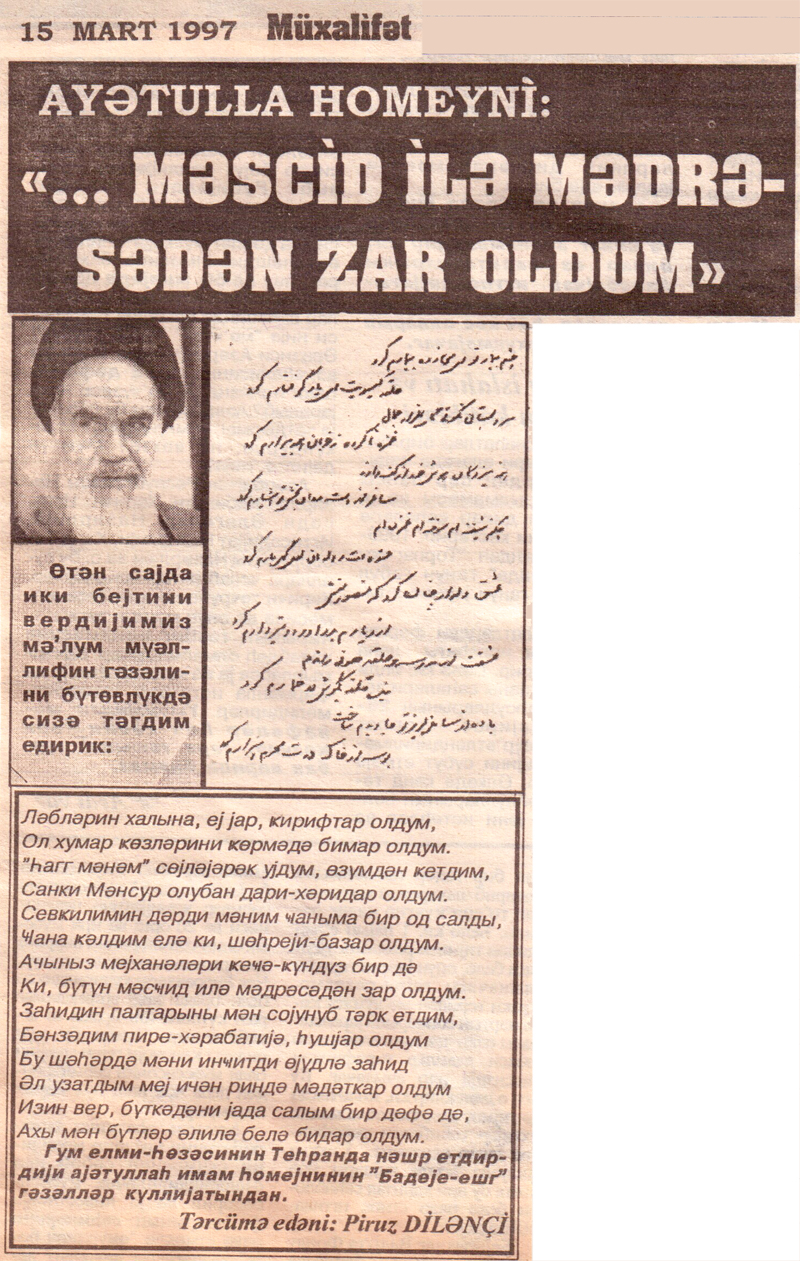
- ^ Khomeini, Ruhollah (15 March 1997). „Ayətulla Homeynì: „… Məscìd ìlə mədrəsədən zar oldum””. Müxalifət (in Azerbaijani and Persian). Translated by Dilənçi, Piruz. Baku. Retrieved 13 December 2017.
- ^ Yahya, Harun. „Global Impact of the Works of Harun Yahya V2”. Secret Beyond Matter. Archived from the original on 26 July 2020. Retrieved 23 April 2020.
- ^ Əlizadə 2020, p. 14.
- ^ Səlimi 1976, p. 38–39.
One comment
Comments are closed.