Afgánországban igen színes a nyelvek terképe. (Sz.)
No persze perzsálkodó kényszeredettséggel Afganisztán néven (ma még) gyakrabban hallani…
Az isztán perzsául annyit tesz, hogy ‘ország’. Magam Magyarul mondom, még ha a tévetegen perzsítók meg(sz)akadnak is ! (Sz.)
| Sorrendben | Nyelv | Lakos – beszélőszám |
|---|---|---|
| 1. | Dari | 20 000 000 |
| 2. | Dél-Pastu | 8 000 000 |
| 3. | Észak-Pastu | 1 700 000 |
| 4. | Dél-Özbek | 3 910 000 |
| 5. | Türkmèn | 1 500 000 |
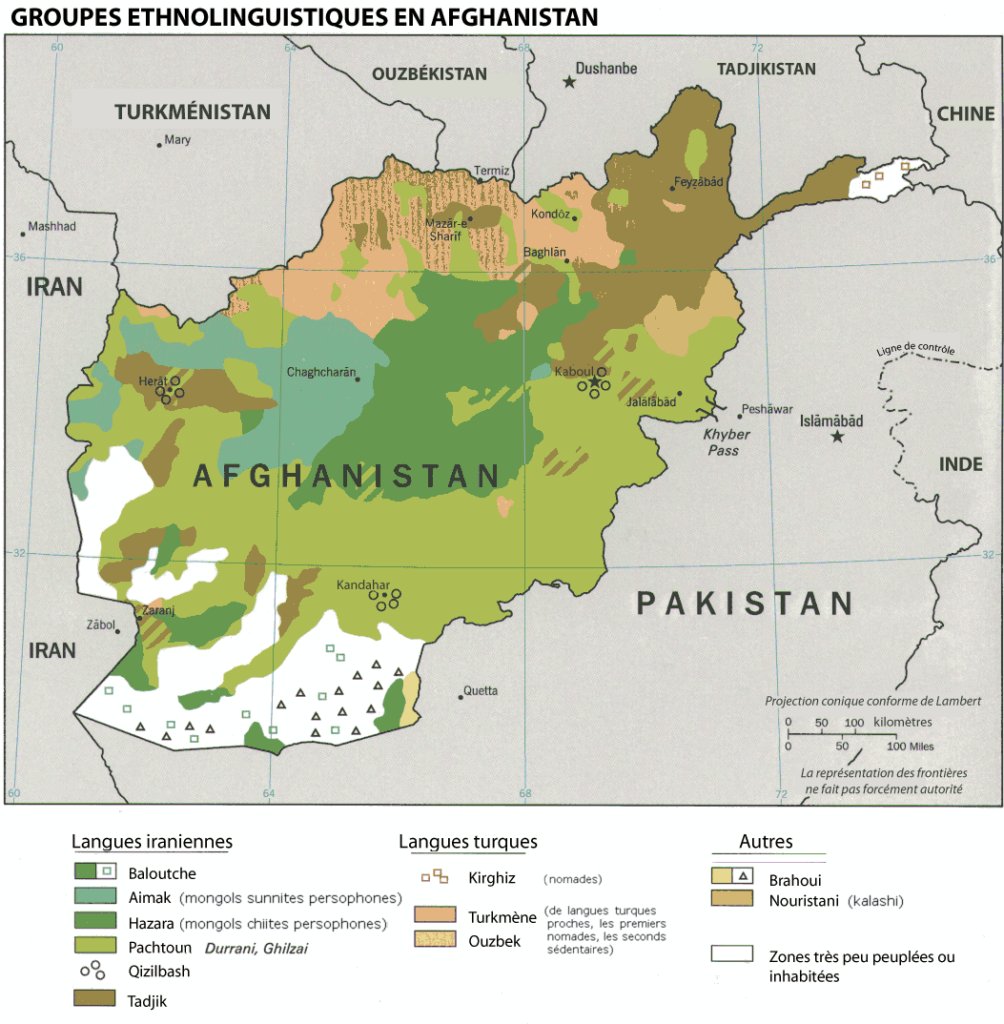
A Pastú پښتو, nyelv a perzsa irodalomtörténetben Afgháni افغانی néven ismeretes. Innen az ország neve is…

A nagyobb afgán nyelvek (eggyszerűsített) elterje-terképe :
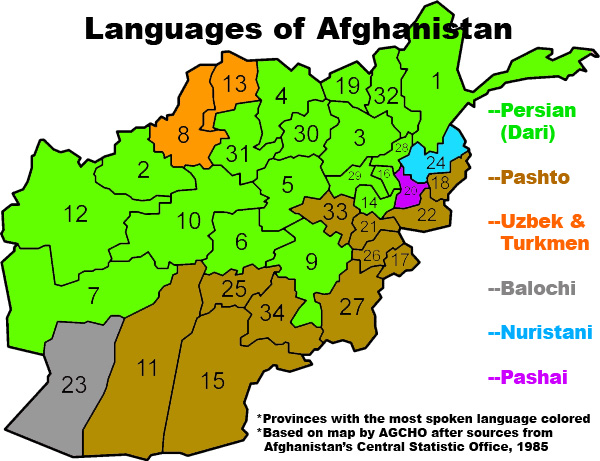
E fönti terkép a balucs(i) nyelvet még csak föltünteti, de a bráui nylvről nem vesz tudomást…
Természetesen lehet finomítani a nyelvi terkép(ek)en, de a nyelvi sokszínűség olyan tarka, hogy tökéletes térképet készíteni szinte lehetetlen …
Akadnak persze egyéb nehézségek is…
Mit tekintünk önálló nyelvnek ?
Milyen néven emlegetük eggy nyelvet ? Önnevén vagy külnevén ? (Sz.)
Ez az alábbi terkép például a tadzsik meg a dari nyelvet eggynek veszi…
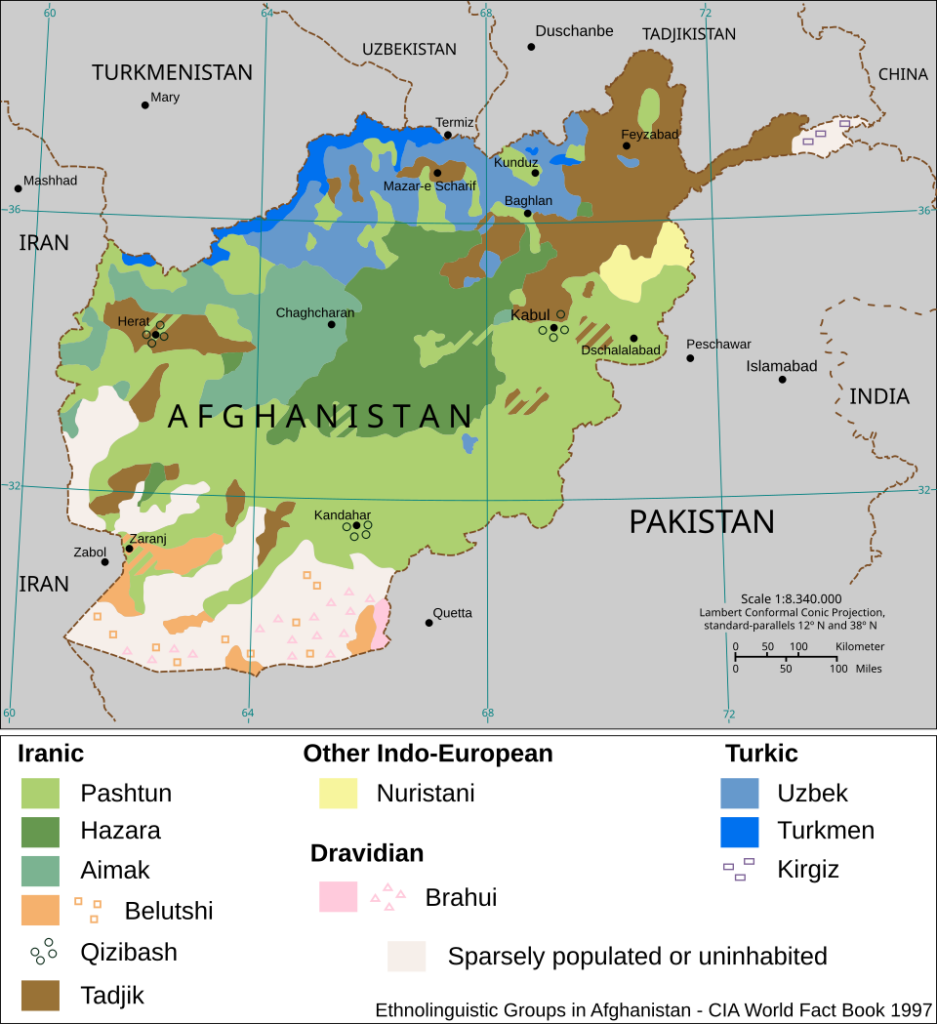
A bevett anglonáci terminologiával szakítva a környező országokat is a saját nevükön nevezem, magyarul : Türkmenország, Özbekország, Tadzsikország, Qırgızország meg Pak(i)ország neveken. (Sz.)
Veszélyeztetett nyelvek Afgánországban
2004-ig csak a Dari meg a Pasto volt(ak) a kormány által támogatott nyelvek. Azóta ugyan változott a helyzet, de az ország kissebbségi nyelvei máig is veszélyben vannak. Az alábbi táblázat bemutatja Afgánország UNESCO által (f)elismert nyelveit. Az UNESCO 23 nyelvet nyilvánított veszélyeztetettnek Afgánországban. Ebből 12-t csak itt Afgánországban ismernek. Eggyet pedig már a fölmérés óta kihaltnak tudnak.
Őshonos vagy honos – ez is egy érdekes kérdés, de az áttelepítések
| Afgáni Nyelv | A nyelv helyzete az UNESCO szerint | Nyelv-család | Nyelv- nemzetség | Honosság | Tudói (beszélői) száma |
|---|---|---|---|---|---|
| Askun (ang. Ashkun) | Definitely endangered | Nurisztáni (Indo-Irani) | Ind(o)-Európ(ai) | (kizárólag) Afgánország | 40 000 (2011) |
| Bráui (ang. Brahui) | Vulnerable | Észak-Dravidia (ang. Northern Dravidian) | Dravida (ang. Dravidian) | Afgánország, Pakisztán táján | 2 864 400 (2018) |
| Közép-Ázsi Arab (ang. Central Asian Arabic) | Definitely endangered | sémmi (ang. Semitic) | Afro-Ázsi(ai) (ang. Afro-Asiatic) | Afgánország, Irán, Tadzsikország, Özbekisztán | 6 000 (2003) |
| Gawar-Bati | Definitely endangered | Indo-Aryan (Indo-Iranian) | Ind(o)-Európ(ai) | Afgánország, Pakistan | 9 500 (1992) |
| Kamkata-vari | Definitely endangered | Nuristani | Ind(o)-Európ(ai) | Afgánország, Pakistan | 40 000 (2017) |
| Mogol / Moγol (ang. Moghol) | Moribund(i) | Moghol(ii) | Mongol | (kizárólag) Afgánország | 200 (2003)(iii) |
| Mundzsi (ang. Munji) | Severely endangered | Iranian (Indo-Iranian) | Ind(o)-Európ(ai) | (kizárólag) Afgánország | 5 300 (2008) |
| Nangalami | Severely endangered | Indo-Aryan | Ind(o)-Európ(ai) | (kizárólag) Afgánország | 5 000 (1994) |
| Ormuri | Definitely endangered | Iranian | Ind(o)-Európ(ai) | Afgánország, Pakistan | 6 000 (2004) |
| Parachi | Definitely endangered | Iranian | Ind(o)-Európ(ai) | (kizárólag) Afgánország | 3 500 (2009) |
| Parya | Severely endangered | Indo-Aryan | Ind(o)-Európ(ai) | Afgánország, Tadzsikország, Uzbekistan | 2 600 (No Date)(iv) |
| Pashayi | Vulnerable | Ind(o)-Árja | Ind(o)-Európ(ai) | (kizárólag) Afgánország | 400 000 (2011) |
| Rushani | Definitely endangered | Iranian | Ind(o)-Európ(ai) | Afgánország, Tadzsikország | 18 000 (1990) |
| Savi | Definitely endangered | Indo-Aryan | Ind(o)-Európ(ai) | (kizárólag) Afgánország | 9 000 (2017) |
| Sanglechi | Severely endangered | Iranian | Ind(o)-Európ(ai) | Afgánország, Tadzsikország | 2 200 (2009) |
| Shughni | Vulnerable | Iráni (ang. Iranian) | Ind(o)-Európ(ai) | Afgánország, Tadzsikország | 75 000 (1990) |
| Sumasti (ang. Shumashti) | Severely endangered | Indo-Aryan | Ind(o)-Európ(ai) | (kizárólag) Afgánország | 1 000 (1994) |
| Terahi / Tirahi (ang. Tirahi) | Moribund(i) | Indo-Aryan | IndInd(o)-Európ(ai) | (kizárólag) Afgánország | 100-5000 (évszám?) |
| Tregámi (ang. Tregami) | Severely endangered | Nuri(sztáni) | Ind(o)-Európ(ai) | (kizárólag) Afgánország | 3 500 (2011) |
| Kalasha-Ala | Definitely endangered | Nur(isztán)i | Ind(o)-Európ(ai) | (kizárólag) Afgánország | 12 000 (2011) |
| Wakhi | Definitely endangered | Iranian | Ind(o)-Európ(ai) | Afgánország, Kína, Pakisztán, Tadzsikország | 58 000 (2012) |
| Wasi-Wari | Definitely endangered | Nuristani | Ind(o)-Európ(ai) | (kizárólag) Afgánország | 8 000 (2011) |
| Wotapuri-Katarqalai | Kihalt (nem maradt élő beszélő) | Indo-Aryan | Ind(o)-Európ(ai) | Afgánország (múlt időben) | ? 0 ? |
Extinct (no living speakers left) / Moribund / Severely endangered / Definitely endangered / Vulnerable
- (i) lit. „verge of death” Language has so few speakers, it is unlikely to survive unless immediate action is taken to preserve it
- (ii) Moghol is the only language in its branch
- (iii) Possibly Extinct
- (iv) Language has died or gone extinct in Afghanistan, but survives elsewhere.
Ajánlott olvasmány :

Moghol – Moγol nyelv
DR. SZABÓ LÁSZLÓ MONGOL NYELVEK, NYELVMENTŐ
Igen. Nem, nem elírás, nem eggy „n” kifelejtése okozta e címet, hanem a legdélnyugatıbb mongol nyelv saját népnevének helyes lejegyzése …
Forrásaim :
Nyáry Szabó László : Szabó-szótár / ideolektusom (mind-máig digitális „kéz”- ill. „gép”-ıratban)
(Sz.) : Számozatlan, forrásolatlan saját(os alkotású) szójavallataim
„Afghanistan”. dbs.org. Bible Society. Retrieved 11 October 2025. Language: Gujari = 18,580
„Afghan – Population Statistics”. Cultural Atlas. 1 January 2022. Retrieved 4 November 2025.
„Language data for Afghanistan”. Archived from the original on 2 December 2022. Retrieved 2 December 2022.
„The 1997 CIA World Factbook Afghanistan” (PDF). Archived (PDF) from the original on 18 July 2022. Retrieved 18 July 2022.
„Pashto”. UCLA Language Materials Project. Archived from the original on 3 January 2009. In Afghanistan, Pashto is second in prestige to Dari, the Iranian language spoken natively in the north and west. Because of the political power of the Pushtuns, however, Pashto has been a required subject in Dari middle schools, and as an official language has been one of the languages of the government. For practical purposes, however, Dari is the language of business and higher education, and so Pushtuns learn Dari.
„Afghanistan”. dbs.org. Bible Society. Retrieved 11 October 2025. Language: Gujari = 18,580
„Afghan – Population Statistics”. Cultural Atlas. 1 January 2022. Retrieved 4 November 2025.
Wahab, Shaista; Youngerman, Barry (2007). A Brief History of Afghanistan. Infobase Publishing. p. 18. ISBN 9781438108193. Afghan Hindus and Sikhs speak Hindi or Punjabi in addition to Pashto and Dari.
Harald Haarmann: Sprachen-Almanach – Zahlen und Fakten zu allen Sprachen der Welt. Campus-Verl., Frankfurt/Main 2002, ISBN 3-593-36572-3, S.273–274; Afghanistan
The Asia Foundation. A Survey of the Afghan People: Afghanistan in 2019. Archived 18 August 2021 at the Wayback Machine
The Asia Foundation. Afghanistan in 2013: A Survey of the Afghan People. Archived 23 March 2021 at the Wayback Machine
The Asia Foundation. Afghanistan in 2006: A Survey of the Afghan People. Archived 28 June 2020 at the Wayback Machine
„Documentation for ISO 639 identifier: prs”. Sil.org. 18 January 2010. Archived from the original on 18 September 2012. Retrieved 5 December 2014.
„The World Factbook: Afghanistan”. Cia.gov. Archived from the original on 4 January 2021. Retrieved 20 July 2020.
R. Farhadi and J. R. Perry, Kaboli Archived 13 November 2021 at the Wayback Machine, Encyclopaedia Iranica, Online Edition, originally in Vol. XV, Fasc. 3, pp. 276–280, 2009.
„Uncommon tongue: Pakistan’s confusing move to Urdu”. BBC News. 11 September 2015. Archived from the original on 20 October 2021. Retrieved 7 December 2020.
„Languages of Afghanistan”. Encyclopædia Britannica. 31 July 2023. Archived from the original on 12 November 2013. Retrieved 17 December 2010.
„Ethnic groups”. BBC News. Archived from the original on 20 November 2001. Retrieved 7 June 2013. Pashtun: Estimated to be in excess of 45% of the population, the Pashtuns have been the most dominant ethnic group in Afghanistan.
O’toole, Pam (6 October 2004). „Afghan poll’s ethnic battleground”. BBC News. Archived from the original on 17 October 2025. Retrieved 16 September 2010.
„The World Factbok – Afghanistan”. The World Factbook/Central Intelligence Agency. University of Missouri. 15 October 1991. Archived from the original on 27 April 2011. Retrieved 20 March 2011. Ethnic divisions: 50% Pashtun, 25% Tajik, 9% Uzbek, 12–15% Hazara[,] minor ethnic groups include Chahar Aimaks, Turkmen, Baloch, and others […] Language: 50% Pashtu, 35% Afghan Persian (Dari), 11% Turkic languages (primarily Uzbek and Turkmen), 4% thirty minor languages (primarily Balochi and Pashai)[,] much bilingualism
„AFGHANISTAN v. Languages”. Ch. M. Kieffer. Encyclopædia Iranica. 15 December 1983. Archived from the original on 29 April 2011. Retrieved 16 January 2025. Official languages. Paṧtō (1) promoted to the status of official language by royal decree in 1936, is the native tongue of 50 to 55 percent of Afghans; as a second language it is spoken by less than 10 percent of the population. The Paṧtō-speaking areas are located in the east, the south, and the southwest of the country. Important colonies of nāqelīn (displaced populations) have settled in Bactria. Persian (2) is the language most spoken in Afghanistan. The native tongue of twenty five percent of the population, it is split into numerous dialects.
„Languages of Afghanistan”. SIL International. Ethnologue: Languages of the World.
- ^ „Afghanistan: Country data and statistics”. Archived from the original on 4 January 2024.
- ^ Jump up to:a b https://en.unesco.org/silkroad/silk-road-themes/languages-and-endanger-languages/pashto?utm_source=chatgpt.com
- ^ Jump up to:a b „Languages – The World Factbook”. www.cia.gov. Archived from the original on 12 November 2025. Retrieved 7 May 2025.
- ^ „Languages of Afghanistan”. Encyclopedia Britannica. Archived from the original on 1 September 2022. Retrieved 12 August 2023.
- ^ „AFGHANISTAN v. Languages”. Encyclopedia Iranica. Archived from the original on 29 April 2011. Retrieved 12 August 2023.
- ^ Rahi, Arwin (16 December 2021). „When Urdu was the most spoken foreign language in Afghanistan”. The Express Tribune. Retrieved 8 January 2025.
- ^ Hakala, Walter N. (2012). „Languages as a Key to Understanding Afghanistan’s Cultures” (PDF). National Geographic. Archived from the original (PDF) on 14 March 2018. Retrieved 13 March 2018.
In the 1980s and ’90s, at least three million Afghans–mostly Pashtun–fled to Pakistan, where a substantial number spent several years being exposed to Hindi- and Urdu-language media, especially Bollywood films and songs, and being educated in Urdu-language schools, both of which contributed to the decline of Dari, even among urban Pashtuns.
- ^ Krishnamurthy, Rajeshwari (28 June 2013). „Kabul Diary: Discovering the Indian connection”. Gateway House: Indian Council on Global Relations. Archived from the original on 17 September 2013. Retrieved 13 March 2018.
Most Afghans in Kabul understand and/or speak Hindi, thanks to the popularity of Indian cinema in the country.
- ^ „AFGHANISTAN v. Languages”. Ch. M. Kieffer. Encyclopædia Iranica. Archived from the original on 29 April 2011. Retrieved 8 April 2012.
A. Official languages. Paṧtō (1) is the native tongue of 50 to 55 percent of Afghans… Persian (2) is the language most spoken in Afghanistan. The native tongue of twenty five percent of the population, it is split into numerous dialects.
- ^ „What Languages are Spoken in Afghanistan?”. 2004. Archived from the original on 7 October 2015. Retrieved 13 June 2012.
Pashto and Dari are the official languages of the state. are – in addition to Pashto and Dari – the third official language in areas where the majority speaks them
- ^ گفتوگوی زهرا مشتاق، روزنامهنگار ایرانی با ذبیحالله مجاهد، سخنگوی طالبان [Interview between Iranian journalist Zahra Mushtaq and Taliban spokesman Zabihullah Mujahid]. Iran International (in Persian). YouTube. 2 October 2021. Archived from the original on 16 February 2025. Retrieved 15 February 2025.
- ^ „MFA denies rumors that Taliban excludes the study of Uzbek language from school curriculum”. Kun.uz. 31 August 2021. Archived from the original on 19 June 2025. Retrieved 16 February 2025.
- ^ Leake, Elisabeth (May 2023). „Constitutions and Modernity in Post-Colonial Afghanistan: Ethnolinguistic Nationalism and the Making of an Afghan Nation-State”. Law and History Review. 41 (2): 295–315. doi:10.1017/S0738248022000530.
- ^ „Citizens say Taliban ignore Uzbek language on National Uzbek Language Day”. Amu TV. 20 October 2024. Archived from the original on 2 November 2024. Retrieved 16 February 2025.
- ^ „Afghanistan: Country data and statistics”. Archived from the original on 4 January 2024. Retrieved 26 June 2023.
- ^ Evans, Lisa (15 April 2011). „Endangered languages: the full list”. the Guardian. Archived from the original on 27 November 2020. Retrieved 5 September 2022.
- ^ „Atlas of the world’s languages in danger”. UNESDOC Digital Library. Archived from the original on 11 November 2020. Retrieved 10 October 2023.
- ^ „Tirahi”. Ethnologue.